
How to Choose the Right Exhibition Stall Fabricator in India
How to Choose the Right Exhibition Stall Fabricator in India for Maximum ROI: The 2026 Playbook
Selecting the right exhibition stall fabricator isn’t about finding the cheapest quote; it is about verifying they own a local manufacturing unit rather than outsourcing, inspecting “work-in-progress” photos from past jobs (not just glossy renders), requesting a line-item quotation for material transparency, and confirming their logistical reach across major Indian venues like Pragati Maidan or BEC to avoid last-minute transit failures.
Your 1-Minute 2026 Cheat Sheet
Short on time? Keep these quick pointers in mind before handing over your budget:
- Skip the Middlemen: Don’t just trust the photos they send. Get them on a quick WhatsApp video call to see their factory floor live. Agencies that outsource to third-party carpenters will cost you your timeline and quality.
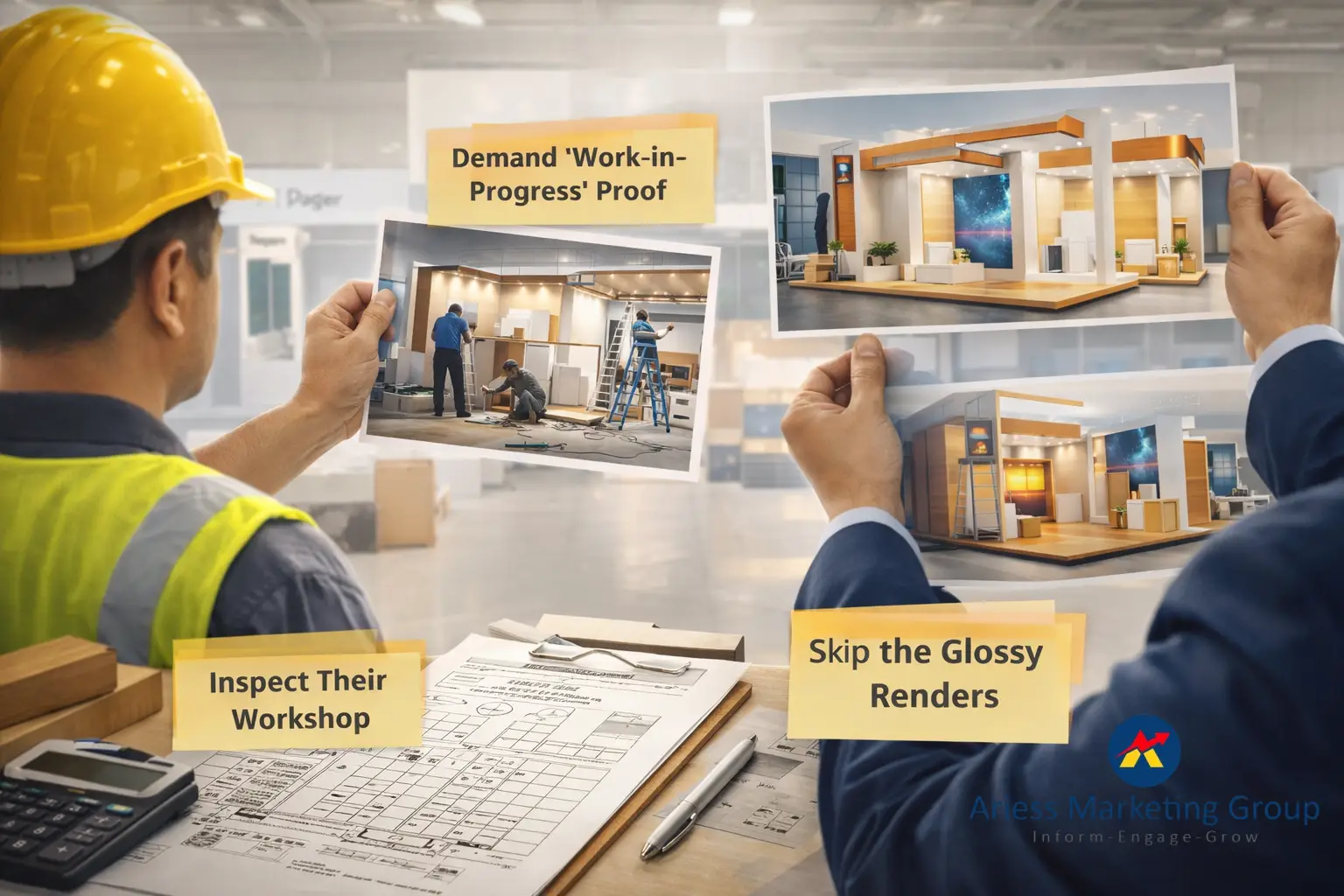
- Demand ‘Work-in-Progress’ Proof: Anyone can make a glossy 3D render. Don’t just look at 3D designs. Demand actual, raw pictures from their previous setups so you can verify the paint quality, hidden wires, and panel joints yourself.
- Location Experience Matters: A contractor who rules Delhi could easily mess up in Mumbai simply because they aren’t used to the strict marshalling yard delays. Pick someone who already has a local setup near your specific venue.
- Get a Detailed Cost Breakdown: A single “total price” quote is a huge red flag. Make your vendor list out every single expense—from the type of paint to labor and ply thickness—so you know exactly what you’re paying for.
- Lock Down the Handover Time: Put a strict penalty clause in your agreement stating the stall must be 100% ready by 6:00 PM the day before the expo. This will save you from last-minute setup nightmares.
The Gap Between a Render and Reality
We have all seen it happen. You walk into an expo hall in Delhi or Mumbai, and there it is: a booth that looks absolutely nothing like the stunning 3D design the brand manager approved. The paint is patchy, the flooring is peeling, and the branding is misaligned.
Why?
Because there is a massive difference between an exhibition booth design company and a true exhibition stall fabricator. One sells you a dream; the other builds the structure. In the Indian market, this distinction is often blurred. You might think you are hiring a manufacturer, but you’re actually hiring an aggregator—a middleman who subcontracts your stall to a third-party workshop you’ve never met.
That creates communication breakage, quality drops, and blown timelines. If you want your brand to dominate the trade show floor in 2026, you need a direct line to the people handling the saw and the spray gun.
Here is exactly how to vet, verify, and hire the partner who will actually deliver.
The “Own Workshop” Mandate (Critical Vetting)
This is the single most significant factor in your decision.
The Indian exhibition market is flooded with agencies. They pitch great designs but possess zero production capability. They take your order and farm it out to a local carpenter.
When things go wrong on set-up night (and things always get tense on set-up night), the agency rep has to call their vendor, who calls their sub-vendor. You lose control.
The Fix:
Demand proof of a dedicated manufacturing unit. You need a custom exhibition stall fabricator who owns their machines, inventory, and labor force.
- Ask for a video call: Don’t just settle for photos. Ask for a live FaceTime tour of their workshop.
- Check their stock: Do they own the trusses, raised platforms, and furniture? Or do they rent everything? Owners treat their gear better than renters do.
- Geography matters: If you are exhibiting at BIEC (Bangalore) but your fabricator is in Delhi with no southern hub, your transport costs will eat your budget. Look for a custom booth builder with a pan-India network of workshops.
💡 Expert Pro-Tip:
“Ask your potential vendor to send you a photo of a current project in their workshop today with a piece of paper showing today’s date. If they hesitate or stall, they are likely outsourcing the work.”
Evaluating Portfolio: Look for “The Build,” Not “The Shine”
Any fresh graduate can whip up a futuristic stand design in 3ds Max or Blender. That tells you nothing about stability or finish.
When reviewing an exhibition stand contractor, skip the software renders. Demand site photos taken during the fabrication and installation phases.
What to look for in real photos:
- Look at the panel joints: A solid contractor uses premium putty and paint so those awkward seams completely vanish.
- Check the wiring: Exposed or hanging cables just scream unprofessional. Everything should be hidden.
- Floor Finish: Are the platform edges taped properly? Does the carpet look tight or wavy?
- Watch the brand colors: Make sure they actually nail your specific Pantone shade instead of just using a generic close match.
Understanding the Fabrication Cost Structure in 2026
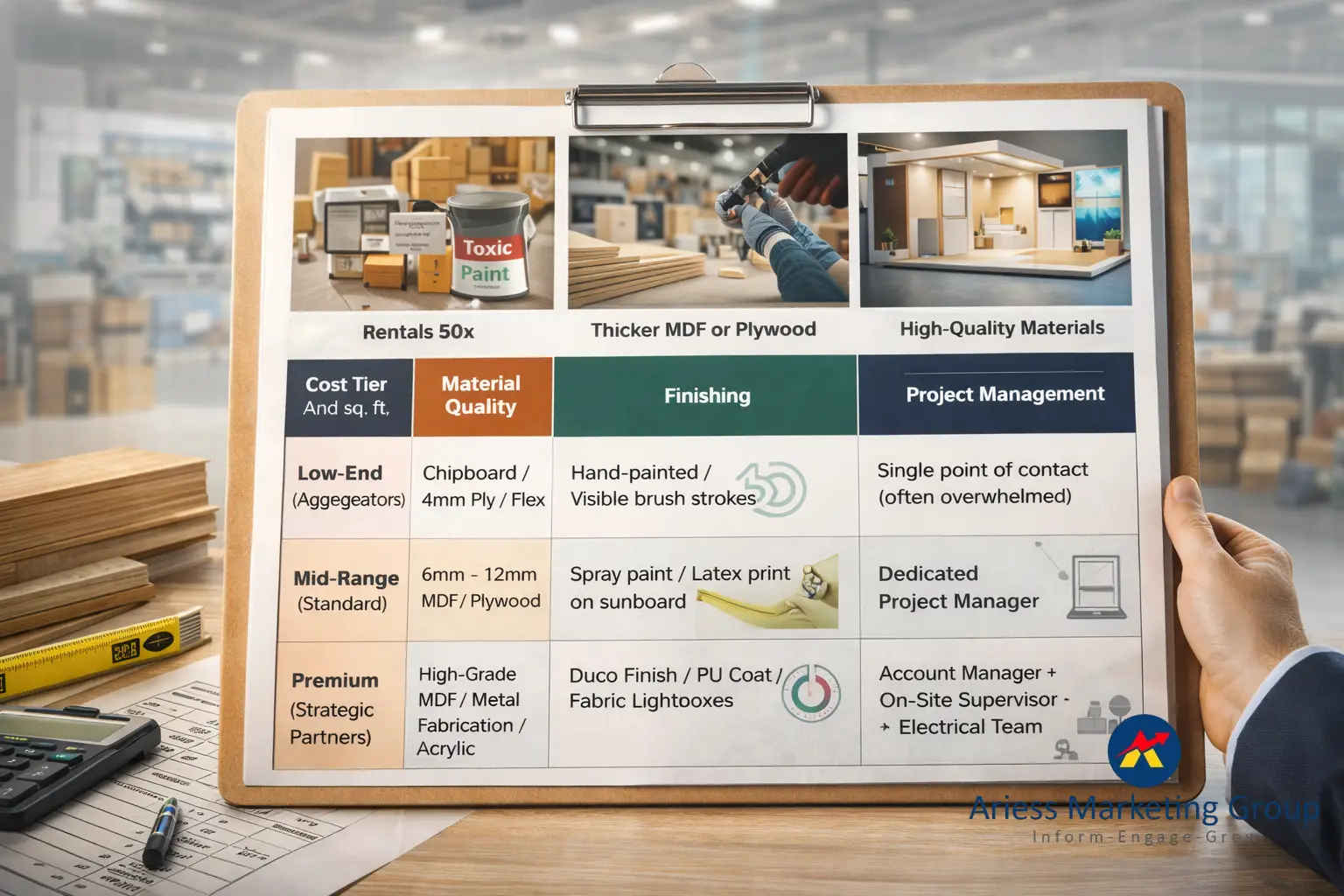
If you request quotes from three vendors, you will likely get three wildly different numbers. Understanding why helps you avoid the “cheap quote trap.”
Budget fabricators save money by using thin materials (3mm ply instead of 6mm or 12mm), toxic solvent-based paints that smell bad on the show floor, and rented furniture that has been used 50 times before.
Here is a breakdown of what you get at different price tiers for exhibition stall fabrication cost in India:
Cost Tier (per sq. ft.) | Material Quality | Finishing | Project Management |
Low-End (Aggregators) | Chipboard / 4mm Ply / Flex | Hand-painted / Visible brush strokes | Single point of contact (often overwhelmed) |
Mid-Range (Standard) | 6mm – 12mm MDF / Plywood | Spray paint / Latex print on sunboard | Dedicated Project Manager |
Premium (Strategic Partners) | High-Grade MDF / Metal Fabrication / Acrylic | Duco Finish / PU Coat / Fabric Lightboxes | Account Manager + On-Site Supervisor + Electrical Team |
Information Gain: In 2026, raw material costs (timber, paint, acrylic) have risen by approx. 15%. If a vendor quotes you 2023 rates, they aren’t being generous—they are cutting corners on the structure.
Custom vs. Modular: Which Path for Your ROI?
Every trade show stall fabricator will push you towards what they are good at. You need to know what you need.
Going Custom (Wood & Paint)
- The Upside: You get to decide exactly how everything looks.
- The Downside: Setting it up at the hall takes a lot of time.
- Best suited for: Big budgets and major product launches.
Going the Modular Way (Maxima/Octanorm)
- The Upside: You can easily reuse the frame for future events.
- Cons: Look can be “boxy” or generic if not designed well.
- Best suited for: Startups, B2B meets, and traveling roadshows.
Don’t believe anyone who claims modular setups look cheap or custom is outdated. Smart agencies blend both—using a sturdy modular frame paired with custom-built front sections for maximum impact.
💡 Expert Pro-Tip:
“If you plan to attend 3+ shows a year, ask for a ‘Retainer & Warehousing’ deal. You pay for the fabrication once, then pay a smaller refurbishment and installation fee for subsequent shows. This drops your per-show cost by 40%.”
The Panic Phase: Project Management Capabilities
The two days before the show opens are chaotic. Aisles are blocked with crates, fork lifts are everywhere, and tempers flare.
You really don’t want a vendor who loses their cool at the last minute. The good ones stick to a strict schedule:
- A month before the event: All drawings and materials need to be locked in.
- Two weeks out: The core build should be finished at their factory.
- Day -7: Dispatch/Logistics (Trucks loading).
- Day -2: Material arrives at the venue. Flooring and structure go up.
- Day -1: Finishing, electrical, deep cleaning. Handover at 6:00 PM.
Ask potential vendors: “What is your backup plan if the truck breaks down or the labor union strikes?”
If your vendor hesitates or stutters when asked about backup teams or local rental partners for emergencies, drop them instantly.
Financial Transparency: Breaking Down the Estimates
A single round-figure cost is usually a bad sign. A single figure like “Total Cost: ₹5,00,000” hides a multitude of sins.
Any reliable stand builder will happily share a complete Bill of Quantities (BOQ) without you having to fight for it.
Make sure your BOQ clearly splits up:
- Platform & Flooring: Specs of the raised platform (100mm height? 4-inch wooden pallet?).
- Wall Structure: Wood specs, paint grade.
- Branding: Print quality (Vinyl vs. Fabric vs. Backlit).
- Lighting: Number of arm lights, concealed LEDs, metal halides.
- Furniture: Specific count and models.
- Labor & Logistics: Installation, dismantle, and transport fees.
If a exhibition stall fabrication company refuses to break this down, they are hiding their margin. This detail is vital when you need to trim costs later. You can see exactly what cutting the “illuminated logo” will save you versus “downgrading the flooring.”
Geographic Intelligence: Fabricating in Delhi vs. Mumbai vs. Bangalore
Here is the dirty reality of the Indian exhibition circuit: a vendor who dominates in Delhi might crumble in Bangalore.
The logistics, union rules, and entry permits vary wildly across states. You cannot assume a “national” exhibition stall fabrication company operates smoothly everywhere unless they have physical assets in that specific region.
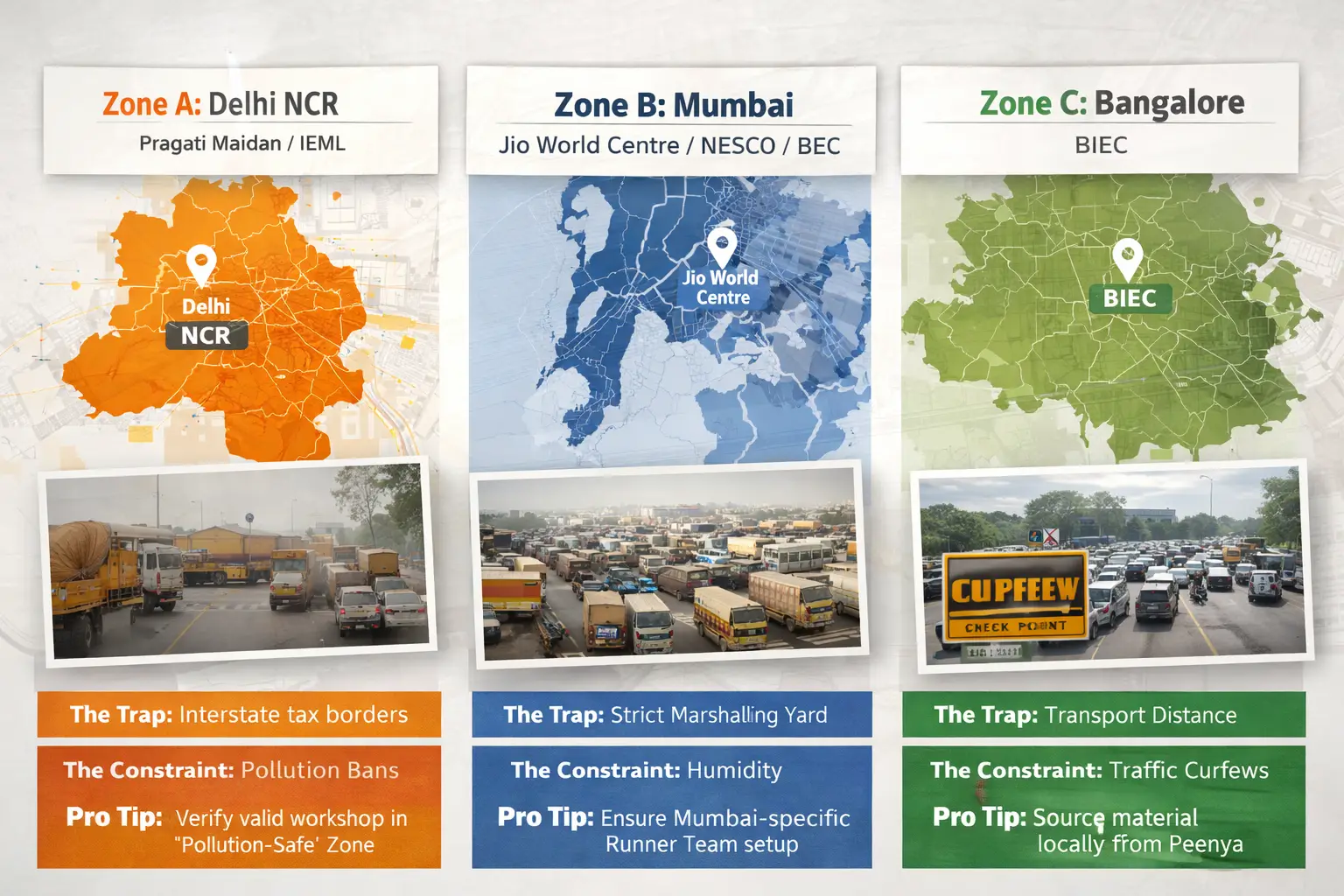
Deep Dive: The Big Three Logistics Zones
Zone A: Delhi NCR (Pragati Maidan / IEML)
- The Trap: Interstate tax borders (entry from UP/Haryana into Delhi) are notorious for stalling trucks. If your fabricator is trucking material from a Noida workshop to Pragati Maidan at 4 PM, they will get stuck.
- The Constraint: Pollution bans (GRAP) frequently stop diesel generator usage and construction activity in winter.
- Pro Tip: Verify that your Delhi-based contractor has a valid localized workshop within the pollution-safe zone or use pre-fabricated modular parts that don’t require on-site sawing/painting during bans.
Zone B: Mumbai (Jio World Centre / NESCO / BEC)
- The Trap: Space and Time. Mumbai venues have incredibly strict marshalling yards. Trucks queue for hours.
- The Constraint: Humidity. Solvent prints and cheap laminates bubble and peel in Mumbai’s moisture if not applied with industrial-grade adhesives.
- Pro Tip: Your execution partner in Mumbai must have a dedicated “Runner Team” distinct from the build team. The Runners handle the marshalling/BMC passes, letting the builders focus solely on the stall.
Zone C: Bangalore (BIEC)
- The Trap: Distance. BIEC is far from the city center and most industrial hubs. Transport costs spiral quickly if the vendor is bringing material from a central city godown.
- The Constraint: Traffic curfews. Heavy vehicles have restricted entry times into the city limits.
- Pro Tip: When executing projects at BIEC, verify your Bangalore agency sources timber and rental furniture from Peenya (the local industrial hub) rather than trucking it down from Hyderabad or Chennai.
The “Invisible” Contracts: Protecting Your Budget
Most brands sign a basic Purchase Order and hope for the best. That is a rookie move.
To secure maximum ROI and protect yourself from a fabrication disaster, your contract needs teeth. Do not rely on standard vendor templates. Add these three specific clauses to your Service Level Agreement (SLA).
Lock Down the Handover Time:
“Get it in writing that they will hand over a spotless, fully lit booth by 6 PM the day before the expo kicks off. For every hour of delay past 8:00 PM, a penalty of 5% of the total project value applies.”
- Why? It forces the fabricator to staff the build correctly rather than relying on a skeleton crew.
The Material Penalty:
“Material substituted without written approval (e.g., using flex print instead of vinyl, or 6mm ply instead of 12mm) results in an immediate 50% refund on that line item.”
- Why? This stops the classic “Switch-and-Ditch” where vendors use cheaper materials once they are on-site and you are too stressed to notice.
The Image Rights Clause:
“Vendor guarantees all design elements, graphics, and structures do not violate third-party IP rights. Vendor indemnifies the Brand against legal claims regarding stall design plagiarism.”
- Why? Copycat stalls are common. You don’t want a legal notice from a competitor because your custom exhibition stall fabricator ripped off a design from Pinterest.
Future-Proofing: Tech Integration & “Smart” Stalls
The static booth is dying. In 2026, exhibition stand construction is merging with IT.
If you are just building walls and sticking posters on them, you are ignored. The top 10% of exhibitors are integrating active tech that drives dwell time. You need a fabricator who understands cable management for server racks, not just carpentry.
Essential “Smart” Fabricator Capabilities:
- Embedded LED Walls: Can they flush-mount P3/P4 LED screens into the wooden structure so it looks like part of the wall, or does it look like a TV hung on a nail?
- Heat Map Sensors: Does your vendor have partnerships with tech providers to install sensors? These track footfall and heat maps, showing you exactly which corner of your stall got the most attention.
- VR/AR Zoning: Fabrication for VR requires specific safety flooring (padded) and rail barriers to prevent users from falling. A standard carpenter won’t know this.
The Green Mandate: Sustainability is No Longer Optional
Global expos are cracking down on waste. Shows in Europe started this; India is following fast.
If your stall generates a mountain of non-recyclable debris, you might face fines from the organizer. Plus, “Green Exhibiting” is a massive PR win.
Ask your Exhibition Booth Fabricator:
- “What happens to the wood after the show?”
- Bad Answer: “We throw it away/burn it.”
- Good Answer: “We de-nail and recycle it for packaging industries.”
- “Are you using Eco-solvent paints?”
- Low-VOC paints improve the air quality around your stall. This matters when your sales team has to stand there for 8 hours a day without getting a headache.
Final Execution Checklist: The “Go / No-Go” Protocol
Before you transfer that 50% advance payment, run this final gauntlet. If the answer to any of these is “No,” move to the next vendor.
Workshop Audit: Have you seen a video call of their workshop with their staff wearing their branded t-shirts?
BOM Breakdown: Do you have a line-item Bill of Materials?
Reference Check: Have you called a client they served in the last 3 months? (References from 2022 are useless).
On-Site Super: Do you have the name and phone number of the specific supervisor who will be at the venue? (Not the Sales Guy).
Render vs. Reality: Have they shown you a “Expectation vs. Reality” comparison of a past project?
Closing Manifesto
The trade show floor is a battlefield. Your stall is your fortress.
Do not hand the keys to the lowest bidder. The difference between a “good price” and a “disaster” is often just 10% of the budget. Choose the exhibition stall fabricator who values engineering over excuses. Choose the team that measures twice and cuts once.
When the hall lights turn on and the visitors flood in, you shouldn’t be worrying about whether the shelf will hold up. You should be worrying about having enough business cards.
Execute properly. Build strong. Dominate the floor.
Make the Final Call with Confidence
Choosing an exhibition stall fabricator is a marriage of convenience for 30 to 60 days. You need trust, communication, and competence.
Don’t be swayed by a fancy PowerPoint pitch. Be swayed by the sawdust on their workshop floor, the thickness of their ply, and the transparency of their BOQ. In a crowded hall, your stall is your only face. Make sure the structure behind it is as solid as your brand reputation.
Verify their assets. Inspect their finish. Control your budget through line items. That is how you win.
FAQs: Selecting an Exhibition Fabricator
Q: How early should I book an exhibition stall fabricator before a show?
A: Ideally, 45 to 60 days prior. This allows 2 weeks for design iterations and 3-4 weeks for workshop fabrication. Last-minute bookings (under 21 days) often incur a “rush fee” of 15-20% and result in lower finish quality due to wet paint not drying in time.
Q: What is the average cost per square meter for stall fabrication in India (2026)?
A: For a custom wooden stall, expect to pay between INR 4,500 to INR 12,000 per sq. ft. depending on design complexity. Modular systems are cheaper, ranging from INR 2,500 to INR 6,000 per sq. ft. Prices vary by city and venue labor rates.
Q: Should I use a local fabricator or fly my team in?
A: Always prioritize a exhibition fabrication services provider with a local presence (e.g., in Delhi for Auto Expo, Mumbai for CPhI). Transporting materials across state lines involves heavy logistics costs and risks interstate tax/entry permit delays.
Q: What is the difference between a shell scheme and a raw space stall?
A: A shell scheme is the standard package provided by the organizer (white walls, simple fascia name). A “Raw Space” is just the concrete floor, requiring you to hire a custom exhibition stall fabricator to build everything from the ground up. Raw space offers far higher branding ROI but requires a separate budget for construction.
Q: Do fabricators handle the dismantling after the show?
A: Yes, reputable agencies include “I & D” (Installation & Dismantling) in their contract. Ensure your contract clarifies who keeps the debris—disposal of exhibition waste is regulated at venues like Pragati Maidan and Bombay Exhibition Center.
Q: Can a fabricator block my competitor’s view?
A: There are strict “line of sight” rules in exhibition guidelines (usually stopping walls at 4ft height for the first 1-2 meters from the aisle). A skilled exhibition stand contractor knows how to design distinct visual barriers using “permissible” elements like transparent acrylics or plants that obey the rules but still offer privacy.
Q: What is the “Mezzanine” rule in Indian expos?
A: Double-decker stalls (Mezzanines) require specific structural stability certificates from a licensed structural engineer. Many generic fabricators cannot legally sign off on these. If you want a double-decker, verify your vendor has an in-house certified engineer.
Q: Why do fabrication quotes exclude electricity charges?
A: Fabricators quote for the internal wiring of the stall. The main power connection (the source) is sold by the venue organizer directly to the exhibitor. Always budget an extra ₹20,000–₹50,000 paid directly to the organizer for the power meter load.