Why Most Brands Fail in Digital Marketing — and How an Integrated Agency Fixes It
The Harsh Truth About Digital Marketing Failure
As professionals operating in the trenches of the modern economy, we’ve witnessed the spectacle: Brand A dumps a significant fraction of its operating budget into what is loosely called “digital marketing.” Month over month, that spend is often on a one-way street, perpetually rising. Yet, ask a candid CEO what they’ve gotten back, and the answer is usually mumbled dissatisfaction. More money, no more movement.
We’ve all seen the toxic advice circulating: “You have to be everywhere!” Brands are advised to launch ads, post incessantly, crank out content, and build a presence on every shiny new platform. The unfortunate outcome is that this advice translates into frantic effort—a constant cycle of “doing everything” while feeling a sinking sensation that nothing is truly working.
The conventional wisdom insists the problem lies with execution—a bad SEO keyword choice, a low Facebook ad bid, or the wrong photo filter. That’s rarely the core issue.
The real problem brands ignore isn’t an isolated tactical blunder. It is systemic. It’s the architecture of their effort. Digital marketing rarely suffers from a skills gap; it suffers from a strategy gap. Simply put: we’ve been tackling a single, sophisticated business problem with a half-dozen independent, single-task vendors.
This article isn’t another critique of poor landing pages. We’re here to look beneath the surface, to examine the foundational digital marketing failure reasons—the strategic gaps and structural weaknesses—that plague most modern enterprises. Most importantly, we will articulate with clarity why embracing the power of a modern, integrated digital marketing agency isn’t just best practice; it’s a necessary strategic restructuring that fixes the core strategic defect, making success not a lucky outcome, but a predictable one.
The Illusion of Digital Marketing Success
Before we dissect why a marketing campaign fails, we have to look at how it fools smart people into thinking it’s working. This phenomenon—the illusion of digital marketing success—is surprisingly potent.
The error is an acute case of tunnel vision, a preference for metrics that feel good over metrics that drive the P&L statement. Marketers fall in love with vanity metrics vs real business growth. This is where likes, impressions, and traffic without conversions are hailed as a success story in the weekly update meeting. “Our awareness is up 300%!” the report will shout, while the lead pipeline remains bone dry.
Why brands think marketing is working when it isn’t typically comes down to one of two things: either they are prioritizing their internal feel-good metrics (we’re busy!) or they’ve hired agencies who only report on these same isolated, siloed numbers that put their specific service in the best light. No matter the reason, the outcome is identical: a marketing machine that costs significant money to appear popular but produces minimal customer growth. The longer this façade is maintained, the steeper the cost of false confidence becomes, eroding not just the marketing budget but the credibility of the entire department. This superficial reporting contributes significantly to the list of why brands fail in digital marketing.
Top Reasons Why Most Brands Fail in Digital Marketing
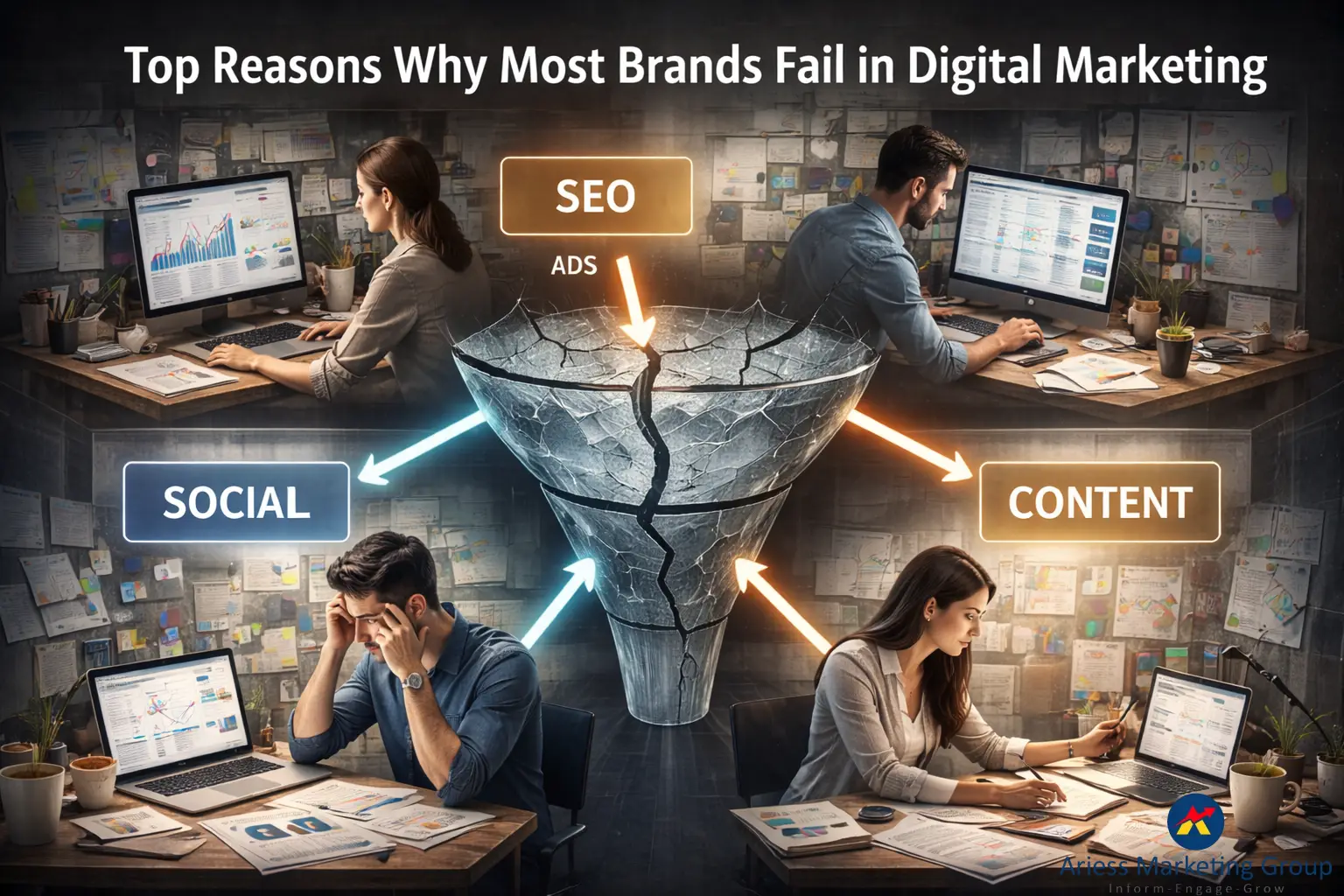
Let’s zero in on the five most critical, and tragically common, strategic flaws that contribute to chronic digital marketing strategy failure. These are not simply common digital marketing mistakes—they are business-model shortcomings:
No Clear Strategy, Only Random Execution
The vast majority of digital activity falls into this category. It’s the execution of isolated chores. You have someone “doing content” because a competitor does. You find yourself posting without purpose on an array of platforms. Your team is running ads without funnel clarity—perhaps targeting vague, top-of-funnel prospects but pushing them immediately to a complex product demo request form. Without a master plan, every dollar spent is effectively gambling, lacking the predictive power needed for ROI-focused marketing.
Fragmented Marketing Channels
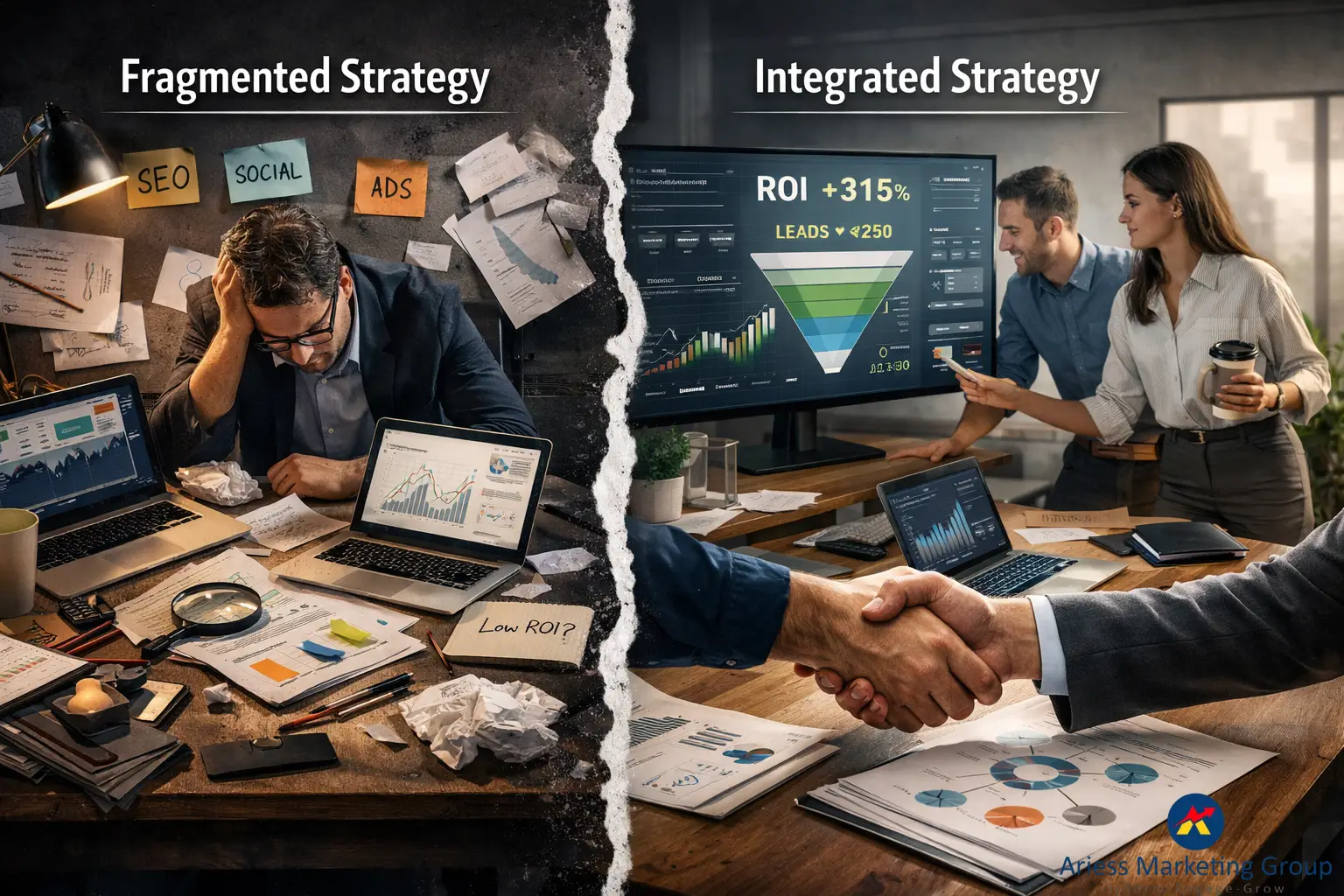
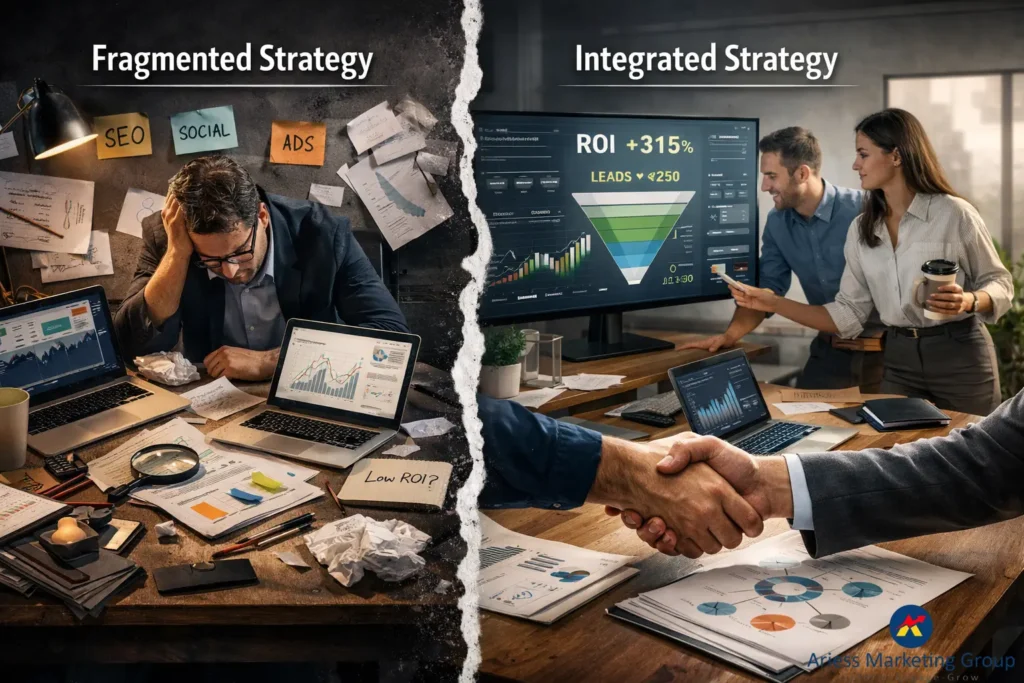
This is perhaps the biggest strategic obstacle. When the team responsible for SEO (traffic/intent) never speaks to the team running paid social (ad copy/image), or the Content Team is unaware of the Sales Team’s newest MQL criteria, you have a fragmented marketing strategy. These critical digital levers—SEO, ads, social, content—are left working in silos. This isn’t just inefficient; it’s a profound systemic failure. Every effort acts as a stopgap rather than a mutually reinforcing engine. This leads to disconnected efforts that kill ROI.
Lack of Audience Understanding
How can you market if you don’t know who is on the receiving end, what they care about, and, crucially, when they are open to receiving certain messages? Too many campaigns send the wrong messaging to the wrong audience because the strategy is based on internal product descriptions rather than external pain points. The fatal error is ignoring the customer journey—the sequence of mental and digital touchpoints that take a prospect from ‘problem’ to ‘solution.’ Successful digital outreach demands rigorous customer journey mapping.
Short-Term Thinking
Business leaders often budget marketing for quarterly success. Digital channels are viewed like vending machines, yet impactful success—especially in search or content—is a long-game investment. This short-term thinking often leads to the mistake of killing campaigns too early. The algorithms, the SEO effort, and the buyer’s natural decision cycle simply haven’t had the requisite time to mature and return profit. Expecting instant results in a complex, multi-touch economy is not ambition; it’s imprudent haste.
No Performance Tracking or Optimization
The marketing stack gathers gargantuan amounts of data today. However, for a worrying number of brands, that data sits like forgotten treasure. Data is collected but never used in any truly meaningful, action-oriented sense. Instead, tactical leaders continue making decisions based on assumptions, not insights. The essential process of continuous improvement—closing the optimization loop—is non-existent. Without transparent, centralized data-driven marketing, continuous performance optimization is a fairy tale.
Why Traditional Digital Agencies Often Make It Worse
Brands, recognizing their internal failure, typically seek a fix by bringing in external experts. But by engaging service-based vs outcome-based agencies, they often replicate and amplify their existing organizational problem.
- Execution without Ownership: You hire a fantastic content specialist. They produce a high-performing eBook. But that content doesn’t perform because the landing page, built by an unaffiliated web designer, is slow. Who is responsible for the overall outcome? No one. The Content vendor executed their brief perfectly. The design vendor executed theirs. The result, however, is a financial failure owned by the client.
- Too many vendors, no accountability: The brand finds itself serving as the costly “General Contractor,” mediating conversations between its Paid Media team, its Email Service team, and its new Social Media vendor. When results suffer, the client must decipher which piece failed, wasting time, money, and focus.
- Why “specialists only” is risky: Imagine a complicated surgical procedure requiring four different specialists—heart, lung, kidney, and nerves. If these specialists meet on the day of the surgery with no one in charge, their independent expertise quickly becomes catastrophic chaos. Digital success, at scale, requires a chief surgeon—the integrated strategist.
What Is an Integrated Digital Marketing Agency?
An integrated digital marketing agency fundamentally steps away from this ‘collection of vendors’ model. Instead, it offers a single-source holistic digital marketing strategy.
In simple terms, a brand engaging in an integrated marketing approach hires one partner responsible for the entire buyer’s journey. This is not just a marketing consultancy; it’s an end-to-end digital marketing services provider whose teams—strategists, copywriters, media buyers, SEO specialists—are organizationally unified, sharing common data, a common goal, and mutual accountability.
The core difference between fragmented vs integrated approach boils down to systemic vs individual success. Fragmented sees success in platform engagement; Integrated sees success in predictable revenue lift. With a unified structure, you get strategy, execution, and optimization under one roof, transforming marketing from an array of independent chores into a cohesive revenue engine. Why integration changes everything is because the agency has to sink or swim based on your ultimate business outcome, not a simple service delivery checklist.
How an Integrated Agency Fixes Digital Marketing Failure
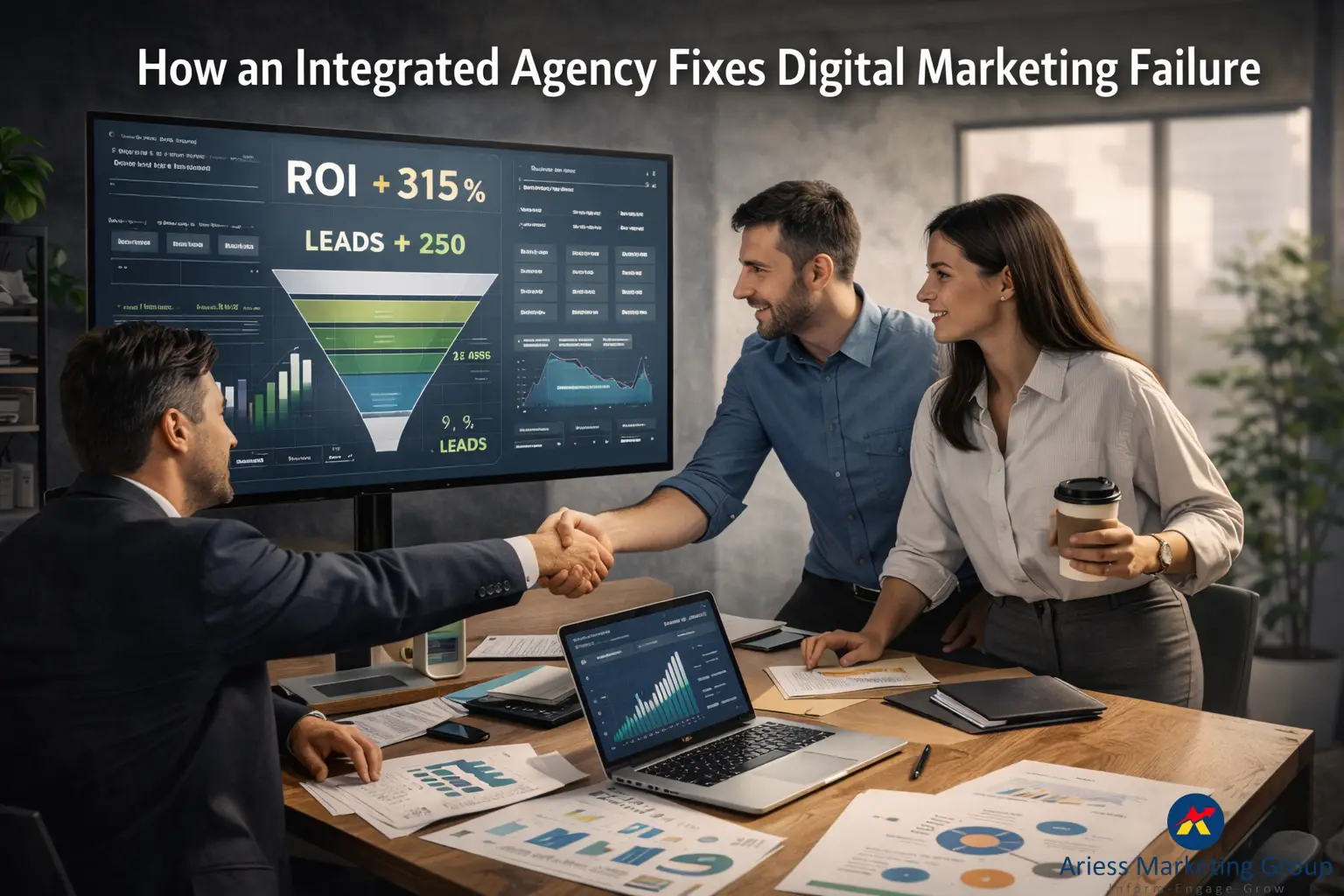
The integrated, full-service digital marketing agency model is the solution because it structurally inverts the fragmented strategic errors identified above:
Unified Strategy Across All Channels
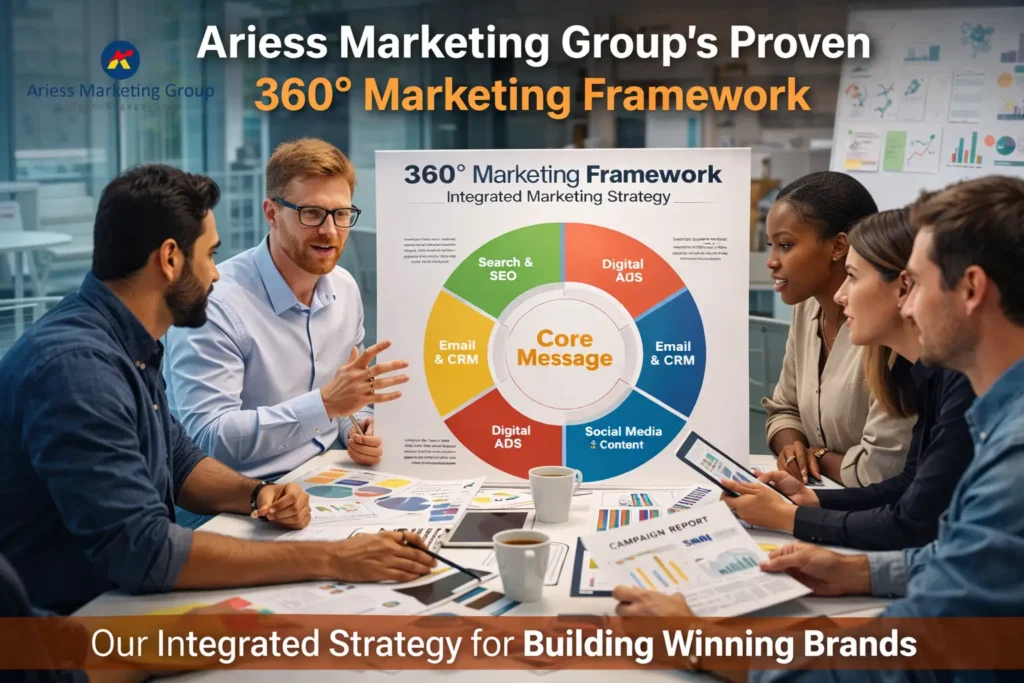
An integrated agency’s first job is establishing a unified strategy across all channels. This means everyone adheres to one goal, one roadmap. They build the plan such that Paid Ads (capturing immediate demand) fuel data points that are used to inform Content Strategy (nurturing future demand), all governed by SEO best practices (ensuring long-term stability). There is clear alignment between SEO, paid, content & social because they work within the same organizational and analytical framework.
Customer-Journey-First Planning
Instead of guessing, the integrated model puts the customer-journey-first planning into immediate effect. This methodology maps every necessary touchpoint that converts, ensuring a visitor in the ‘Discovery’ stage is never hit with an aggressive, ‘Commitment’-stage message. By demanding messaging based on intent, not assumptions, integrated agencies cut conversion friction and optimize ad relevance across platforms.
Consistent Brand Experience Everywhere
Accountability to the overarching narrative eliminates silos that destroy trust. The content the buyer encounters during their research via an Organic Search link, the specific data-driven marketing ad targeting them on LinkedIn, and the look of the final e-commerce store—it must all share the same narrative, voice, and quality. This commitment to brand consistency ensures you are telling the same story, same value, all platforms, building powerful market authority.
Data-Driven Decisions, Not Guesswork
A cornerstone of the model is consolidated, cross-channel reporting via robust performance dashboards. Since the SEO, Social, and Ads team leaders are looking at the same final outcome dashboard (e.g., Cost Per Qualified Lead), insights gleaned from one channel are immediately operationalized in all others. This ensures data-driven decisions, not guesswork, enabling effective cross-channel marketing strategies and driving continuous performance optimization.
ROI-Focused Execution
Accountability is key to fixing the systemic digital marketing failure reasons. An integrated agency operates purely on ROI-focused execution. Metrics that matter to business are prioritized, forcing the agency to eliminate waste and non-contributing activities. Their mandate is to continually scale what works, cutting what doesn’t, using sophisticated reporting to create the ideal, profitable pathway for the client’s business growth.
Real Impact: What Brands Gain From an Integrated Approach
Moving beyond tactical services unlocks compounding business benefits that dramatically impact the bottom line:
- Better Marketing ROI: Unified reporting immediately reduces wasteful spending by identifying which combination of touchpoints, not just which single ad, generated the most profit.
- Higher Conversion Rates: A consistent message based on meticulous customer journey mapping lowers resistance and builds confidence, speeding up the path to conversion.
- Stronger Brand Authority: Consistent visual identity, brand voice, and clear messaging across channels contribute to immediate market perception, bolstering long-term trust and customer LTV.
- Faster Decision-Making: All the data—from Google Ads, CRM, Email, and organic search—lives in one transparent hub, allowing business leaders to bypass fragmented reports and make swift, confident, data-driven marketing decisions.
- Predictable Growth Model: An end-to-end digital marketing services structure allows the agency to establish a predictable engine where a given spend generates a measurable return, moving away from annual marketing gambles.
When Does a Brand Need an Integrated Agency?
There are pivotal moments when a brand’s reliance on fragmented marketing strategy turns from a persistent frustration into an existential problem:
- Marketing costs are rising, returns are falling: The sheer complexity of vendor management is crushing budgets while accountability disappears. This is the moment for marketing alignment.
- Growth has plateaued: The tactics are optimized, but the business can’t climb to the next level of growth because its channels aren’t feeding one another strategically.
- Too many agencies, no clarity: You have separate reporting, three conflicting sets of KPIs, and your time is wasted on vendor-coordination. It’s time to consolidate power.
- Rebranding or scaling phase: The complexity of launching a major initiative requires all internal and external marketing arms to move as one—making a single, integrated strategy partner indispensable.
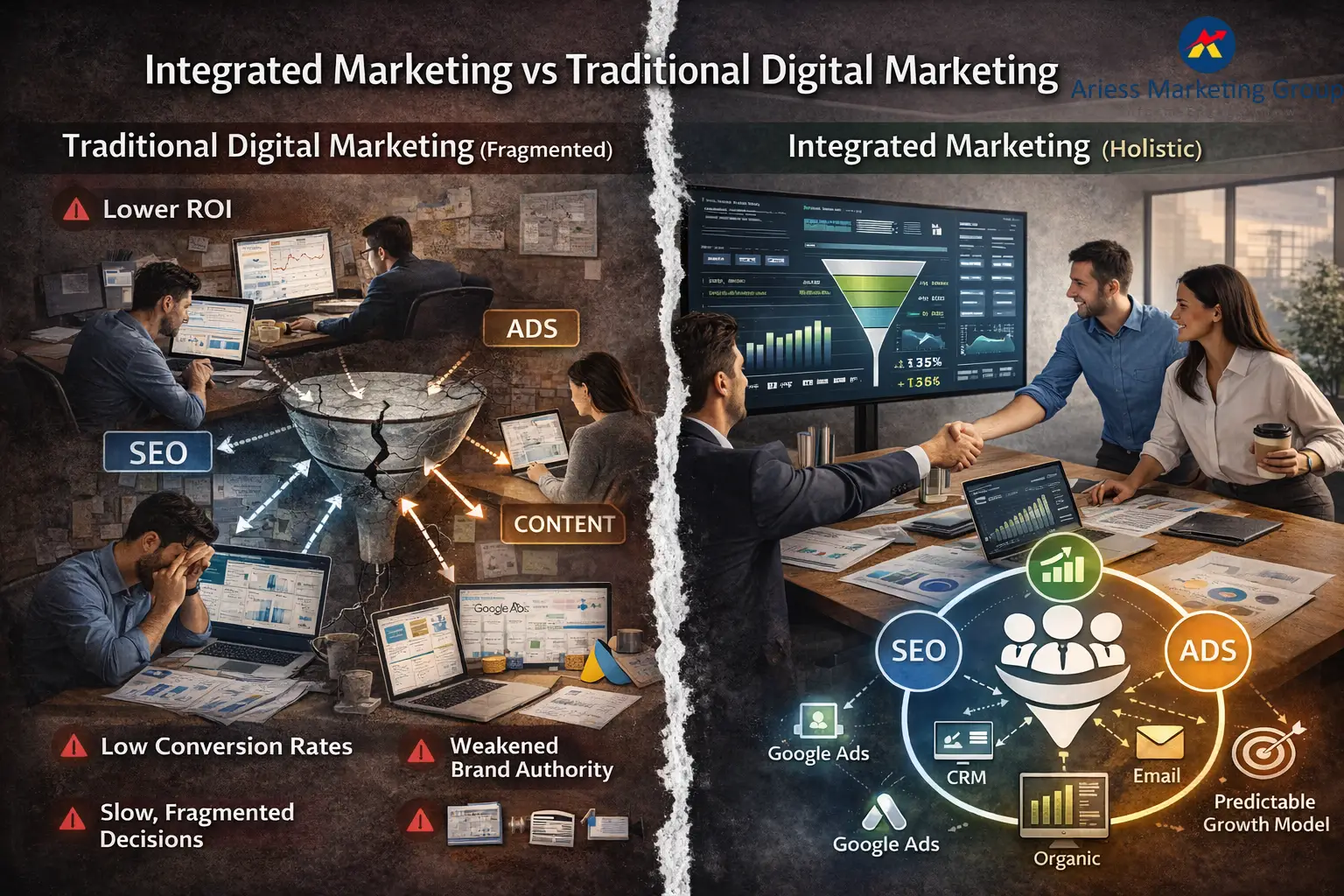
Integrated Marketing vs Traditional Digital Marketing
Strategy Pillar | Traditional Digital Marketing (Fragmented) | Integrated Marketing (Holistic) |
Strategy Focus | Platform-centric (“What is best for Instagram?”) | Business-centric (“What is best for ROI?”) |
Execution | Specialists operate in a vacuum, focusing on task completion. | Cross-functional teams collaborate on shared campaigns with a mutual client KPI. |
Accountability | Distributed. Blame-shifting is common; no one owns the end result. | Centralized. One single entity is accountable for overall business growth metrics. |
Data Usage | Tactical and isolated; little to no true cross-channel marketing insight. | Strategic. Unified data-lake informs predictive modeling and immediate performance optimization. |
Budgeting | Often reactionary; determined by channel inventory. | Predictive; determined by desired revenue goals and calculated customer journey mapping. |
Result Metric | Output: Impressions, clicks, traffic. | Outcome: Customer acquisition cost (CAC) and Lifetime Value (LTV). |
The Future of Digital Marketing Belongs to Integrated Brands
The complexity of digital engagement today makes the old fragmented agency model fiscally, operationally, and strategically irrelevant. The consumer expects an omnichannel experience where your brand consistency is flawless and your relevance is uncanny.
Fragmented marketing will die because it is built on a defunct premise: the idea that digital platforms operate independently of one another. As data-driven marketing grows more critical and regulatory privacy barriers rise, the need for efficiency and a deep, unified holistic digital marketing strategy has become a mandate.
What smart brands are already doing differently is realizing that digital mastery isn’t about winning on one platform; it’s about making every platform work together to move the buyer down a singular, expertly paved conversion pathway. An integrated system, armed with the insight from end-to-end digital marketing services, is uniquely equipped to succeed.
Conclusion: Digital Marketing Doesn’t Fail — Strategy Does
We have seen ample evidence that the tools of the trade are sound. The core reason why digital marketing doesn’t work is always strategic dissonance. When brands are not achieving predictable returns, they have a broken operating model—a strategy that has been accidentally and defensively compiled instead of thoughtfully, cohesively built.
The journey away from a self-sabotaging fragmented marketing strategy starts with acknowledgement: Digital marketing will be inefficient, confusing, and financially stressful until strategy, execution, data, and accountability are all governed by a single system.
Key Takeaways:
- Your marketing should only ever be reporting on ROI-focused marketing and real customer acquisitions, not superficial, vanity metrics.
- Stop operating with disconnected efforts that kill ROI; insist on marketing alignment across all channels.
- Solving systemic problems requires a structural solution, making the integrated digital marketing agency model the ideal partnership for any scaling business.
Ultimately, embracing a true holistic digital marketing strategy transforms marketing from an expense center perpetually looking for an answer, into a profitable, accountable, and predictable engine of growth.
Struggling with disconnected marketing efforts, rising costs, and constantly wondering why brands fail in digital marketing while yours is stuck?
It’s time to transform from fragmented spending to a focused integrated marketing approach. Discover how our full-service digital marketing agency can deliver a singular, accountable strategy that unlocks real, measurable, and predictable growth.